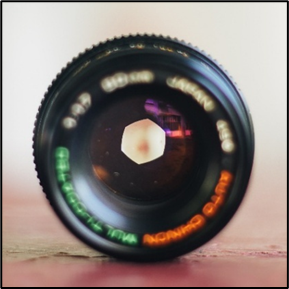
Take a look at the photos on your smartphone. Tap the Info button, and you will see information similar to the image above. One of the details shown is the f-value.
Did you know that f-values such as f/1.4, f/2.8, or f/8 displayed in the photo information are not just random numbers? They represent the aperture value, which is the key to one of the most loved effects in photography: a blurred background (background blur), also known as “bokeh” (a Japanese word meaning blur).
What Is Aperture?
Imagine aperture as the iris of your eye.
- In the dark: Your iris enlarges to allow more light in
- In bright light: Your iris shrinks to reduce the amount of light
The aperture inside a camera lens works the same way. It is an adjustable metal opening that expands and contracts to control how much light enters the camera.
The “f” on Your Lens Is Not Just a Number — It Is a Physical Measurement
Below are images taken using a 50mm F1.4 lens:
Based on the images above, from left to right the photos become progressively darker as the f-value increases from 1.4 to 16.
To understand why this happens, consider the following formula:
For example, using a 50mm f/1.4 lens at aperture f/1.4:
Meanwhile, when using a smaller aperture such as f/16:
The lens opening appears as follows:
The values d (diameter) and A (area) refer to the physical size of the light opening inside the lens.
|
f-value
|
Diameter Calculation
|
Diameter (mm)
|
Radius (mm)
|
Aperture Area (mm²)
|
|
f/1.4
|
50mm/1.4
|
35.714
|
17.857
|
1001.0
|
|
f/2
|
50mm/2.0
|
25.000
|
12.500
|
490.9
|
|
f/2.8
|
50mm/2.8
|
17.857
|
8.929
|
250.5
|
|
f/4
|
50mm/4.0
|
12.500
|
6.250
|
122.7
|
|
f/5.6
|
50mm/5.6
|
8.929
|
4.464
|
62.6
|
|
f/8
|
50mm/8.0
|
6.250
|
3.125
|
30.7
|
|
f/11
|
50mm/11
|
4.545
|
2.273
|
16.2
|
|
f/16
|
50mm/16
|
3.125
|
1.563
|
7.7
|
From the table above, we can see that at f/1.4, the aperture area is large, allowing more light to enter and resulting in a brighter image. Conversely, at f/16, the aperture opening is very small, allowing less light in and producing a darker image.
That is why f/1.4 is called a large aperture, while f/16 is called a small aperture — because the aperture area at f/1.4 is larger than at f/16.
The Mathematics Behind Aperture
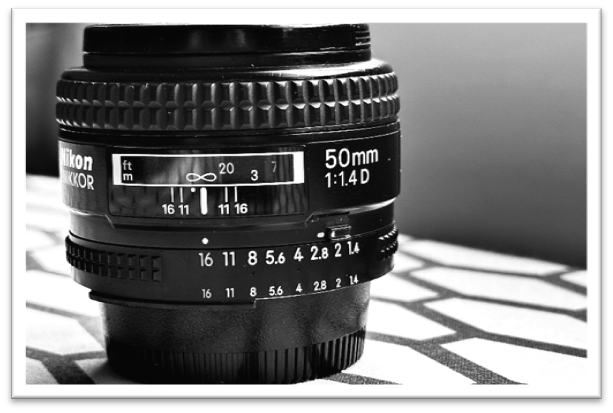
You may wonder why the sequence of values is 1.4, 2, 2.8, 4, 5.6… instead of 1, 2, 3, 4, 5.
The answer lies in the relationship between the area and diameter of a circle.
To reduce the amount of light by half, we need a new circle whose area is half of the original circle.
Let Alama be the original area and Abaru​ the new area:
Let dlama be the original diameter and dbaru the new diameter:
Solving this equation gives:
Example Calculation
- To get to the next f-value:
We obtain the next aperture value f/2.
- To get to the next f-value:
Hence, we obtain the next aperture value, f/2.8.
The table below summarizes the relationship between old and new f-values:
|
f-value
|
Original Diameter
|
New Diameter
|
New f-value
|
|
f/1.4
|
35.71mm
|
25.26mm
|
f/2
|
|
f/2
|
25.00mm
|
17.68mm
|
f/2.8
|
|
f/2.8
|
17.86mm
|
12.63mm
|
f/4
|
|
f/4
|
12.50mm
|
8.84mm
|
f/5.6
|
|
f/5.6
|
8.93mm
|
6.31mm
|
f/8
|
|
f/8
|
6.25mm
|
4.42mm
|
f/11
|
|
f/11
|
4.55mm
|
3.22mm
|
f/16
|
Despite the lengthy calculations, there is actually a simpler way to obtain f-values — by using a geometric progression:
|
Nilai f
|
 |
Nilai f Baru
|
|
f/1.4
|
 |
f/2
|
|
f/2
|
 |
f/2.8
|
|
f/2.8
|
 |
f/4
|
|
f/4
|
 |
f/5.6
|
|
f/5.6
|
 |
f/8
|
|
f/8
|
 |
f/11
|
|
f/11
|
 |
f/16
|
Aperture Effects: Depth of Field and Bokeh
Besides affecting the brightness and darkness of an image, the f-value also plays a role in determining the extent of sharpness in a photograph, known as the Depth of Field. This, in turn, creates the Bokeh effect, which refers to the blurring of the background (background blur) or the foreground (foreground blur).
The images below were taken by placing the focus point on the foreground subject, using different f-values:
|
f/1.4
|
f/2.8
|
f/8
|
f/16
|
 |
 |
 |
 |
 |
 |
|
f/1.4
|
f/8
|
It can be seen that images taken with a lower f-value produce a shallower depth of field, resulting in a more pronounced bokeh effect compared to images taken with higher f-values. This is why only the subject in focus appears sharp.
In simpler photographic terms, a lower f-value narrows the area of focus, producing stronger bokeh or clearer background separation. This happens because the depth of field becomes shallower, which helps isolate the subject from its surroundings.
This shallow depth of field and the resulting bokeh effect are especially appealing in genres such as portrait and macro photography, where the goal is to draw the viewer’s attention directly to the subject by blurring distracting elements in the background or foreground.
Meanwhile, higher f-values are used to achieve a wide depth of field, so that all elements in the image appear sharp and clear, from the subject to the background. This is important in situations such as group photos, landscape photography, or architectural photography, where overall clarity and sharpness throughout the image are required.
So from now on, every time you take a photo, or smile while looking through the collection of images on your smartphone, remember that each photograph is shaped by the harmony of light, glass, and mathematics—an elegant aperture equation that quietly composes beauty behind the lens.
Rujukan
- Pitici, M. (Ed.). (2013). The best writing on mathematics 2012. Princeton University Press.
- Kingslake, R., & Johnson, R. B. (2009). Lens design fundamentals (2nd ed.). Academic Press.
- Friedman, A., & Ross, D. (2002). Mathematical models in photographic science. Springer Science & Business Media.
- Hoffman, C., & Driggers, R. (Eds.). (2015). Encyclopedia of optical and photonic engineering (2nd ed.). CRC Press. https://doi.org/10.1081/E-EOE2

Author: Dr. Mohd Ezad Hafidz Hafidzuddin (Mathematics Unit/ Collaborator of Computational Mathematics and Ethnomathematics Laboratory (CMEL))
Date of Input: 21/01/2026 | Updated: 21/01/2026 | norhidayahche
MEDIA SHARING