Authors: Amar Luqman, Malathi Letchumanan & Siti Nur Iqmal Ibrahim
Institute for Mathematical Research (INSPEM)
Universiti Putra Malaysia
Mathematics education worldwide recognizes fractions as a fundamental component that is essential for understanding more advanced mathematical concepts such as ratios, proportions, decimals, and percentages. At the school level, fractions help students understand quantitative reasoning by demonstrating how a whole can be divided into smaller, equal, and accurate parts. Failure to develop a solid understanding of fractions at an early stage creates a domino effect that hinders the mastery of more advanced academic topics. This lack of mastery is clearly reflected in the performance of Malaysian students in international assessments.
Data from the Trends in International Mathematics and Science Study (TIMSS) indicate a decline in the mathematics and science achievement of Malaysian students to below the international average. According to the Malaysia Education Blueprint 2013–2025, 35% of students in Mathematics and 38% in Science failed to achieve the minimum proficiency level. These figures represent a significant increase compared with 1999, when only 7% of Mathematics students and 13% of Science students failed to reach the minimum standard. This pattern of underachievement is further reinforced by the results of the OECD's Programme for International Student Assessment (PISA). In the Quantity domain of PISA 2012, Malaysian students achieved an average score of only 409, well below the OECD average of 495. Malaysia ranked 52nd out of 65 participating countries, behind neighbouring Southeast Asian countries such as Singapore (573), Vietnam (511), and Thailand (427). These findings demonstrate that weak mastery of fundamental concepts such as fractions has a systemic impact on Malaysia's mathematics performance on the global stage (Kor et al., 2019; Mokhtar et al., 2019).
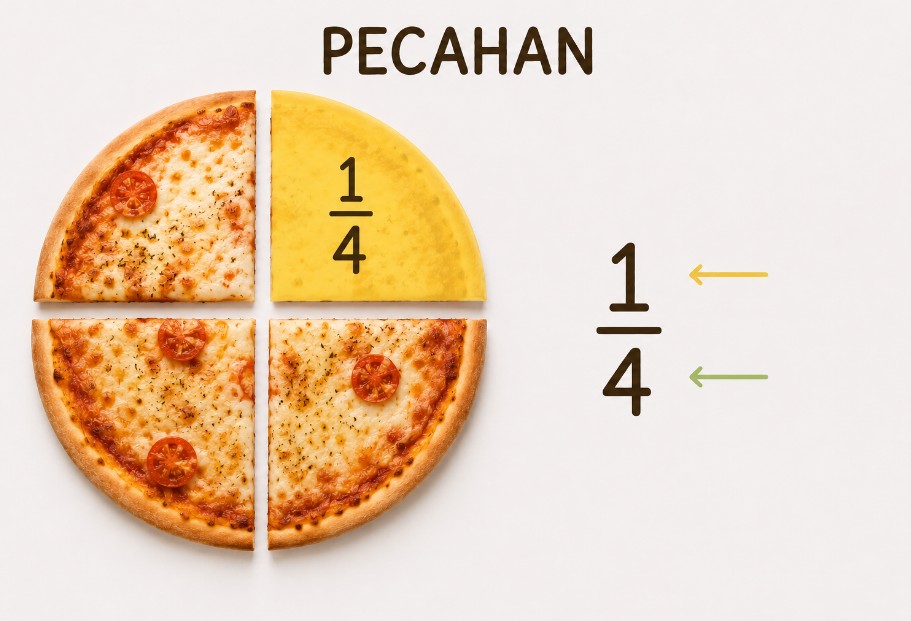
Fractions play a vital role in everyday life because they enable us to manage, divide, and measure quantities accurately when whole numbers are no longer sufficient. We use fractions, often without realizing it, when measuring ingredients while cooking, dividing time into quarter-hour intervals, or calculating discounts while shopping. Even simple activities such as cutting a pizza or cake fairly to share with family members require an understanding of fractions. Mastering this concept not only makes everyday tasks easier but also develops logical thinking and better decision-making skills.
Mastering Fundamental Concepts
Despite their importance, fractions remain one of the most challenging mathematical concepts for students worldwide. This issue is universal, cutting across different education systems and cultural backgrounds. In the United States, data from the National Assessment of Educational Progress (NAEP) consistently show that students perform significantly worse on fraction-related tasks than on other mathematics topics. Similar challenges are experienced by students in Malaysia and many other countries, indicating that mastery of fractions is a global issue in mathematics education (Syed Azman et al., 2025).
The primary difficulty arises when students must transition from thinking in terms of whole numbers to understanding fractions. Failure to make this transition results in weak fraction number sense among Malaysian students, which ultimately contributes to a decline in overall mathematics achievement. This complexity is evident when students struggle to solve problems involving part-whole relationships, equivalence, and fraction operations. The impact is particularly apparent when students attempt basic operations such as adding fractions with different denominators. Many fail to view fractions as representing a single quantitative value and instead perceive them as two separate whole numbers (Siegler et al., 2011; Syed Azman et al., 2025).
One of the main contributing factors is the continued reliance on traditional teaching methods that encourage students to memorize algorithms and computational procedures without understanding the underlying abstract concepts. When instruction focuses primarily on rote memorization, systematic errors continue to recur whenever the topic is assessed. Students without a strong conceptual foundation tend to rely on incorrect procedural methods and struggle to reason mathematically. Another major cognitive obstacle is the phenomenon known as "whole number bias." Students frequently revert to whole-number reasoning when dealing with fractions. This misunderstanding leads to persistent misconceptions, such as believing that a fraction with a larger denominator must be smaller simply because the denominator contains a larger numeral—for example, assuming that 1/4 is smaller than 1/8 because 8 is greater than 4. Students also experience cognitive conflict because they transfer their prior understanding of whole numbers to fractions. They often assume that multiplication always increases a number's value. When multiplying fractions produces a smaller value, their existing mental framework is disrupted. The abstract nature of fractions therefore demands a substantial cognitive shift, and without appropriate conceptual guidance, learning fractions becomes an overwhelming challenge for many students (Obersteiner et al., 2019; Syed Azman et al., 2025).
To bridge the gap between procedural fluency and conceptual understanding, teaching strategies need to shift from traditional methods to interactive and multimodal approaches. To address early misconceptions, teachers can utilize pedagogical techniques based on everyday concrete objects such as apples, pizzas, or folded paper. These tangible materials effectively help students understand fractions as equal parts of a whole (Syed Azman et al., 2025).
The selection of fraction models and manipulative materials that are appropriate to students' cognitive development should receive careful attention during teaching and learning. Visual representations play a crucial role in helping students better understand the abstract nature of fractions. Physical teaching aids such as fraction strips and fraction rods promote active student engagement while strengthening number sense through visual and tactile experiences (Syed Azman et al., 2025; Wilkie & Roche, 2023).
However, manipulatives should not be used in isolation. These teaching aids need to be integrated into a broader conceptual framework that includes problem-solving activities and active learning strategies. When implemented comprehensively, such approaches not only strengthen students' procedural knowledge but also equip them with the skills to apply fraction concepts in more advanced and challenging mathematical tasks (Syed Azman et al., 2025).
Alongside technological advancements, digital applications and interactive software such as GeoGebra have become increasingly important in mathematics instruction. These technologies help students understand the abstract nature of fractions through engaging visualizations and simulations. The integration of technology into learning not only enhances students' interest in mathematics but also enables them to develop a deeper conceptual understanding.
Mastering fractions is essential in mathematics education because they form the foundation for many more advanced mathematical topics. Failure to understand fractions at an early stage can have long-term consequences for students' academic achievement. Therefore, more creative, interactive, and student-centred teaching approaches should be strengthened so that fractions are no longer perceived as difficult or burdensome. By combining effective teaching strategies, manipulative materials, and technological support, students can develop a stronger understanding of fractions and apply this knowledge effectively in their everyday lives.
References
Kor, L.-K., Teoh, S.-H., Binti Mohamed, S. S. E., & Singh, P. (2019). Learning to Make Sense of Fractions: Some Insights from the Malaysian Primary 4 Pupils. International Electronic Journal of Mathematics Education, 14(1), 169-182.
Mokhtar, M. A. M., Ayub, A. F. M., Said, R. R., & Mustakim, S. S. (2019). Analysis of Year Four Pupils’ Difficulties in Solving Mathematical Problems Involving Fraction. International Journal of Academic Research in Business and Social Sciences, 9(11), 1560–1569.
Obersteiner, A., Dresler, T.S., Bieck, M., & Moeller, K. (2019). Understanding fractions: integrating results from mathematics education, cognitive psychology, and neuroscience, in Constructing Number: Merging Perspectives from Psychology and Mathematics Education. 135–162.
Siegler, R., Thompson, S.C. A., & Schneider, M. (2011). An integrated theory of whole number and fractions development. Cognitive Psychology, 62(4), 273–296.
Syed Azman, S.l., Maat S.M., & Khalid, F. (2025). Addressing fraction comprehension:
Global perspectives and Malaysian educational strategies, International Journal of Evaluation and Research in Education (IJERE), 14(3), 2107–2117.
Wilkie, K. J., & Roche, A. (2023). Primary teachers’ preferred fraction models and manipulatives for solving fraction tasks and for teaching. Journal of Mathematics Teacher Education, 26(6), 703–733.
Sources from:
https://www.majalahsains.com/cabaran-pecahan-isu-global-dalam-pendidikan-matematik/
Date of Input: 06/07/2026 | Updated: 06/07/2026 | norhidayahche
MEDIA SHARING